|
We've come all
the way to our last addition to our very
basic Reggae instrumental, where we're
adding the final touch. First, we're going
to add percussion and that's before we'll
take a look and listen to the clavinet and
something I have come to call "pucking
guitar".
PERCUSSION
Roughly,
you can divide the percussion in Reggae in
two categories: the (hand) drums and, yes,
well, let's call them "effects"
for lack of a better term. Both categories
have their distinct approach of the rhythm,
both categories add their own distinct vibe
to the rhythm as well. Sometimes, you want
to emphasize one category, while at other
times you might want to make a combination.
All these variations do actually give a
totally different sound and feel to the
rhythm and this is something one should be
aware of, in my humble perception. After
all, you really don't play a Nyabinghy
rhythm over a love song unless you're
ignorant or arrogant and you don't want to
be that.
Reggae
started in Jamaica, and the music has a lot
of Caribbean elements. You'll find a lot of
Latin percussion instruments like shakers,
the guiro and what have you. Still, you can
not approach Reggae Music as a Caribbean
music only. This is because of Rastafari,
and Rastafari focuses on Africa. Musically,
this is clear in the percussion and
especially in the hand drums category.
hand
drums
The three
main hand drums used in Reggae percussion
must be the Conga's, Bongo's and the Kete.
Especially the Kete drum is important, after
all it's part of the drums used in that very
particular Rhythm of Rastafari called
Nyabinghy, covered
earlier in this tutorial.
Before
anything else: what's really, really
important to know about Reggae hand drum
percussion is that it is first and foremost
about the sound of the drum. Just
imagine in yourself a bass and drum line.
Just the bass and the drums. Then, you just
hear one flam shot on a Kete. It's like the
Rastaman enters the music with the sound
of Africa. You don't have to be a Rasta
to feel this, but Rasta is very much
connected with Reggae Music and therefore
it's not unwise to consider this rather
essential musical piece of knowledge, even
on a basic music-technological level.
Another
thing that is kind of important is the
rhythm that the hand drums play. Why? Well,
check this first: Reggae is very much a
music where togetherness or unity/Inity is
perfectly illustrated in the music itself.
Where the three brass players create a sound
together, the riddim section does the same.
By not doing too much, leaving room for the
other instrument, the togetherness becomes a
new sound. The hand drums add to the drum
(the drum kit/drummer), playing around the
rhythm that the drums play. Subtle, but
present.
In a way,
you can say that the rhythm of a Reggae hand
drum percussion instrument presents the
sound of the drums more than a specific
rhythm. The sound of the hand drums, it's
presence if you will, is more important than
the rhythm itself. Yes, you can extract a
few typical rhythms often used, but these
rhythms only emphasize all the principal
talk. The function of the hand drum in
Reggae is to add the African Connection, the
sound of Africa to a music that
originated in Jamaica.
Knowing and
applying this knowledge leads to a genuine,
authentic hand drum part in your Reggae
track. Ignoring it can disable you from
reaching the point where you can create your
own Reggae hand drum percussion. Unless you
know what you do and you want to create a
Samba Band experience, ignoring all these
principals I just mentioned can lead to just
that, your Reggae sounding more like Samba.
Bring on the tequila, or the sinsemillia?
Having been
through that, let's continue to actually add
a hand drum rhythm to the track we're
working in.
Ouch.
There's
something else. When I started to write this
tutorial, I used the General Midi Format and
a SoundBlaster soundcard. I truly do not
remember the exact times in which I wrote
chapters like this
one, but currently (September 2014)
things like ports and channels are
irrelevant with software titles like Reason
and Ableton. That's why I am going to
assume, that you know how to add percussion
samples to your sequencer. If not, you can
still use the conga samples from your
standard General Midi Drum roll.
For this
chapter in the tutorial, I'm going to use
some samples created by online artist
Blaminack. He builds his own Kete Drums and
sells it to the well known Dub Act Twilight
Circus, so you're talking about the real
deal. When you want to go along with this
tutorial Click
HERE to download a zip with the Wave files
or HERE
for a Reason Refill containing the samples.
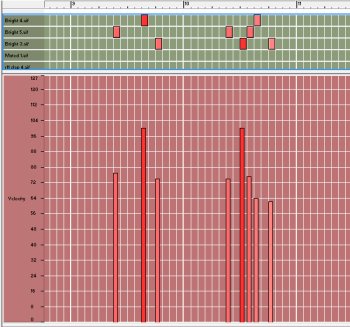
Create the
following pattern in your sequencer (note
the sample names and the velocity!) (click
to enlarge):
EXAMPLE0037.MP3
Be sure to
check the audio file as well. First you will
hear the Kete rhythm, then silence, then the
drums and the Kete together. Consider that
there's use of 16th notes. Mind the
particular filenames as well! Here's the
drum and percussion again so you'll know
what to build:
EXAMPLE0038.MP3
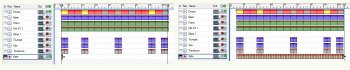
Got
it? Now simply copy and paste the 2 bars of
hand drum percussion rhythm until the end of
the tune (click to enlarge).
That's
it?
Well,
yes and no.
Many
percussion players I've seen in action
trying to play along with a Reggae band have
a tendency to go wild. To make variations
all the time, resulting in a continual drum
roll throughout the whole tune. That's not
what we want. Remember, the goal is to add a
sound, a vibe. When you over-do things, the
percussion will no longer show it's
"sound-strength", it will take
over everything and that's not what you
want.
You
can of course make variations, but know what
you do. Listen again and again to especially
Roots Reggae from the later 1970's. Do not
try and get your ideas from Nyabinghy bands
like Ras Michael and the Sons of Negus
because these do not represent the standard
way of Reggae. It's like taking Bob Marley's
music as the standard of your average Reggae
tune: you will never be able to dig the
simplicity that really is the strength of
Reggae more than anything else. And no, this
is not dissing Ras Michael or Bob Marley: it
is respecting the special position both have
in the spectrum of Reggae Music.
Freestyling
can be done, too. You just need to know what
you're doing. Take the principals I've just
shared as some sort of guideline, it won't
hurt you. Check out the You Tube Video below
for a true freestyle champion: Burning
Spear.
percussion
effects
Next
to the hand drums category, there's that
other category which I call "percussion
effects". I have no idea what else to
call it, but it covers the whole range and
spectrum of other percussion instruments.
Especially South-American and African
percussion instruments are used, but it's
definitely not limited to that. Most common
are shakers, scrapers, cowbells and
woodblocks. Most should even be on your
General Midi Drum piano roll.
Again,
the message is: do not over-do things. It's
even stronger for this category. Consider
the following thoughts and tips, before we
will actually construct some thing.
Sometimes,
you need to dig through complexity in order
to discover the simplicity. Sometimes, you
need to come up with a rather complicated
sounding definition to discover a principal
thing. That's exactly what we're going to do
right now and it's this: a definition of
rhythm.
A
rhythm is a repetition of one shots on an
instrument during the course of several
bars.
So,
what am I saying here? I'll give a few
examples. Imagine, one hit on a Cowbell
between the second and third count on every
second bar. Or a Cowbell shot on the first
count of the first bar, then on the fifth,
ninth, et cetera. Just this is already a
rhythm. In fact, this is the kind of very
basic interpretation of rhythm that will
provide you with authentic Reggae percussion
effects.
Basically,
what you do is making a loop of eight bars,
put one shot of any percussion on any one of
the eight points (when you divide the
measure into eight) in the second bar, and
repeat that one shot in the fourth, sixth
and eighth bar. When
you do this, you will have factually created
a percussion element that is, let's say,
fully functional.
Is
that all?
Well,
no. But it's a start and building further on
that start will not lead you to
nonsensicalities.
Now,
load a shaker, woodblock and cowbell and
make the following rhythm (4 bars), then
copy-paste it throughout the entire track
(click to enlarge):

EXAMPLE0039.MP3
As
you can hear in the audio example, when the
percussion instruments and the drums come
together, you will hear much more of a
typical Reggae drum than if you would have
left the drums like that.
To
conclude this part about the Percussion
Effect category, I'd like to leave you with
some more general tips concerning specific
percussion instruments.
-
The
tambourine is often used to enhance the
Hi Hat pattern. There are even drummers
that have a tambourine attached on their
Hi Hat stand.
-
Use
one shot instruments like the jingle
bells and Vibraslap just once or twice,
or mix them really soft in the audio mix
(oh, wait, we're still in the midi
phase).
-
Try
putting a woodblock at two places in a
bar, and repeat the same thing every two
bars. You will have de facto constructed
a rhythm.
Remember,
percussion is an important element in Reggae
Music. Do not over-do it!
CLAVINET

click to enlarge (Source: Wikipedia)
I'm
going to contradict myself. In a previous
paragraph I told you to not take Bob
Marley's music as the standard for your
average Reggae tune, and now I'm going to
propose an instrument that was typical for
the sound that Bob Marley created. Remember,
he used the Reggae rhythm and added all
kinds of western flavors on top of it like
sliding guitars and blues organs and what
have you. There's a very interesting
documentary about it called "Catch
a Fire".
One
of the instruments often used in Bob
Marley's music is the clavinet (see
picture). You could call it an instrumental
percussion instrument, the way it is used in
Reggae Music. Mind you, I know a lot more
about drums and bass then I know about
keyboards, chords and scales and the like,
so this is all I know and I know that I know
very, very little. But, again, let me bow
down low and tell you what I know, to use a
humble variation on a theme. Let me just
tell you how I usually implement the
clavinet and let me point out to midi.dubroom.org
where you can find and use midi files by
Sure Dread, who knows so much more about
these things. Studying the midi files is
like a course in itself.
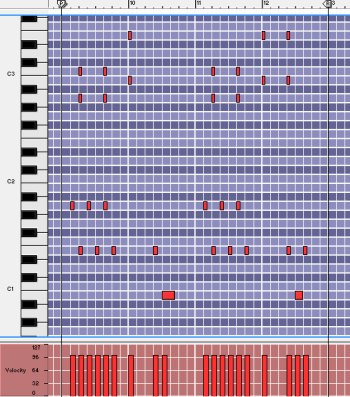
I
see the clavinet keyboard divided in a left
side (for the left hand) and a right side.
The left hand plays a percussive, simplified
variation of the bass line. The right hand
plays two or three tones from the chords of
the riddim section. It goes like this (click
to enlarge):
EXAMPLE0040.MP3
The
audio fragment opens with drum, bass and
percussion. After a while the clavinet
(taken from Reason's Factory Sound Bank)
drops in for eight bars and then you'll have
4 bars of drum bass and percussion again.
When you did not yet know about the
clavinet, I am sure you will recognize the
sound nevertheless. No, not just in Bob
Marley's music. And you know, echo's on a
clavinet sound just crucial. More later.
PUCKING
GUITAR
Where
the clavinet can be seen as a percussive element
for the bass and the chords, the
"pucking guitar" as I call it
focuses stricktly on the bass. Roughly
spoken: the guitarist plays the bass line
along with the bass guitar, but with muted
tones and with a plectrum. Sometimes, the
"pucking" is changed with a hook
or a lick, only to go back and accompany the
bass.
It's
very hard to make a nice pucking guitar line
with midi, but for this tutorial we'll do
it. What you'll need is a muted guitar
sound, copy the bass line in the piano roll
for the guitar, and transpose it to an
audible range. Transpose as in octaves, not
tones. But you figured that one out. You can
then add 16th or extra 8th notes in the
line, so that the guitar is playing with the
rhythm of the bass line. Like this (click to
enlarge):

EXAMPLE0041.MP3
Here,
the audio fragment opens with the bass for 8
bars, followed by the bass and the pucking
guitar for 8 bars. As you hear, 16th tones
are added on ever 3rd count in every second
bar. Seel below for a comparance between the
bass line and the guitar line (click to
enlarge):
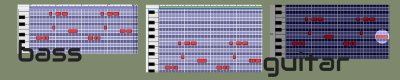
And
of course, like with the clavinet, the eight
bars we made is copied and pasted. Yes, you
can -and should- make variations here and
there but that's something your own
creativity will have to lead you. We're just
constructing a riddim, not the next Reggae
hit.
Congratulations!
We've made a full instrumental Reggae track
with midi!
GOT
REASON 3.04 AND/OR UP? CLICK HERE FOR AN RPS
OF THE TRACK THUS FAR
|